
















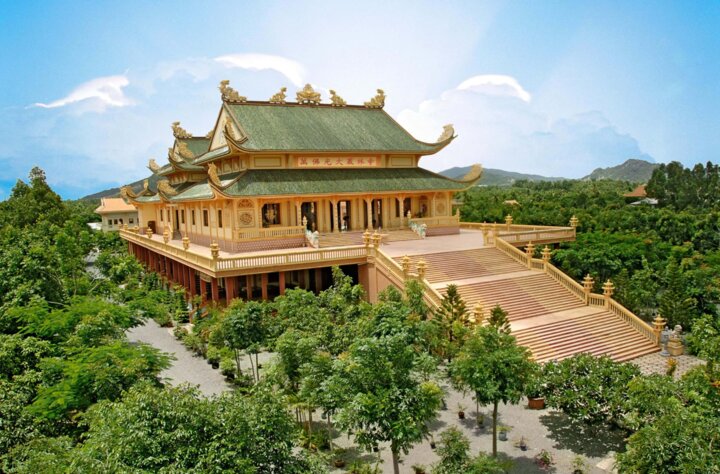
1. Overview of Dai Tong Lam Pagoda in Vung Tau
1.1. Location and Scale of the Dai Tong Lam Pagoda in Vung Tau Grounds
Dai Tong Lam Pagoda in Vung Tau is located along National Highway 51, in Phu My City, Ba Ria – Vung Tau Province, one of the major transport routes connecting Ho Chi Minh City with the southern coastal provinces. Thanks to its convenient location, visitors can easily reach the pagoda by private car, motorbike, or interprovincial coach. In addition to its convenient access, the surrounding area features an open and peaceful atmosphere, separated from the noise of urban life, creating ideal conditions for pilgrimage, Buddhist practice, and sightseeing.
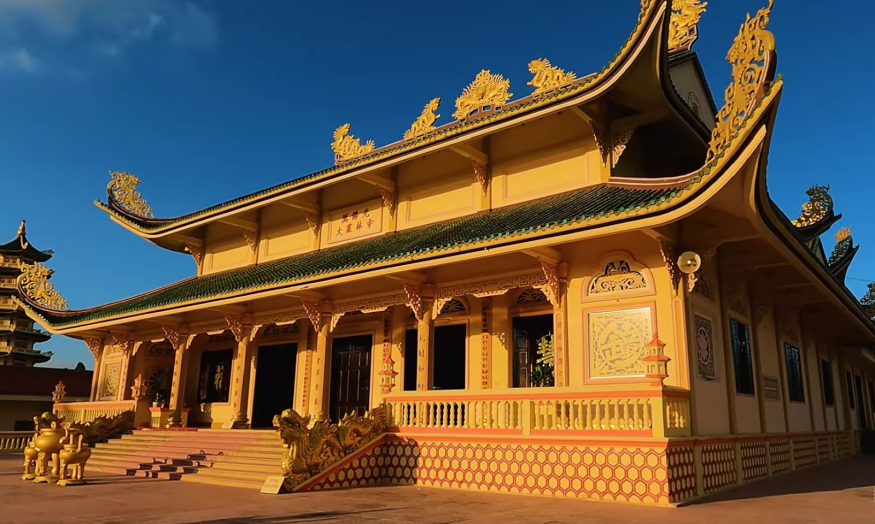
An area inside Dai Tong Lam Pagoda in Vung Tau (Source: Collected)
What makes Dai Tong Lam Pagoda in Vung Tau particularly distinctive is its extremely spacious grounds, covering more than 54 hectares – a scale rarely seen among Buddhist complexes in Vietnam. The entire site has been carefully planned, harmoniously combining spiritual architecture with lush natural landscapes. Rows of mature trees, expansive lawns, ponds, and stone-paved pathways create a peaceful and spacious setting, allowing visitors to experience a sense of tranquility from the moment they enter the pagoda grounds. This vast space not only serves pilgrims and Buddhist ceremonies but also provides an ideal environment for contemplation, meditation, and restoring balance in one's spiritual life.
1.2. Why Visit Dai Tong Lam Pagoda in Vung Tau?
Beyond its impressive scale, Dai Tong Lam Pagoda in Vung Tau is also regarded as one of the important Buddhist centers in southern Vietnam, bringing together spiritual, cultural, and Buddhist educational values. The pagoda hosts numerous large-scale Buddhist activities, including retreats, Buddhist festivals, and study programs for monks, nuns, and Buddhists from across the country. For this reason, it is more than simply a place for pilgrimage; it is also a space that nurtures spiritual life and helps people rediscover inner peace amid the pressures of modern life.
In addition to its profound spiritual significance, the pagoda attracts visitors with its distinctive architectural and artistic values. Its monumental Buddhist statues, numbering in the thousands, together with structures such as the main hall, stupas, statue gardens, and lecture halls, are all elaborately designed and deeply influenced by traditional Buddhist aesthetics. Each architectural detail is not only visually appealing but also conveys profound philosophical ideas about human life. As a result, Dai Tong Lam Pagoda in Vung Tau is not only a sacred spiritual destination but also a distinctive cultural and artistic space that attracts large numbers of visitors, Buddhists, and those interested in exploring spiritual values whenever they visit Ba Ria – Vung Tau.
2. History and Development of Dai Tong Lam Pagoda in Vung Tau
2.1. Origins and the Original Vision
Dai Tong Lam Pagoda in Vung Tau was founded in 1958 under the leadership of Most Venerable Thich Thien Hoa, a highly respected monk who made significant contributions to the development of Vietnamese Buddhism during the 20th century. From the very beginning, the pagoda was not established merely as a place for Buddhist practice, but also reflected a broader vision of creating a large-scale Buddhist center capable of training monks and spreading Buddhist teachings to the wider community.
The decision to select a large tract of land in the Phu My area – which was relatively undeveloped at the time – demonstrated the long-term vision of earlier Buddhist leaders. Its spacious, quiet environment, separated from the noise of urban areas, was considered ideal for developing a sustainable center for Buddhist study and practice. Within this context, Dai Tong Lam Pagoda in Vung Tau gradually established its foundations, laying an important cornerstone for its journey toward becoming one of the major Buddhist centers in southern Vietnam.
2.2. Expansion and Development Through the Years
After its establishment, the pagoda continued to expand and develop through various historical periods. From its initial basic structures, the complex gradually received more systematic investment, with the addition of a large main hall, lecture halls, monastic quarters, meditation halls, an inner monastery area, and numerous supporting facilities serving Buddhist study and daily activities. Each stage of construction reflected the dedication of senior Buddhist monks, Buddhists, and benefactors from Vietnam and abroad.
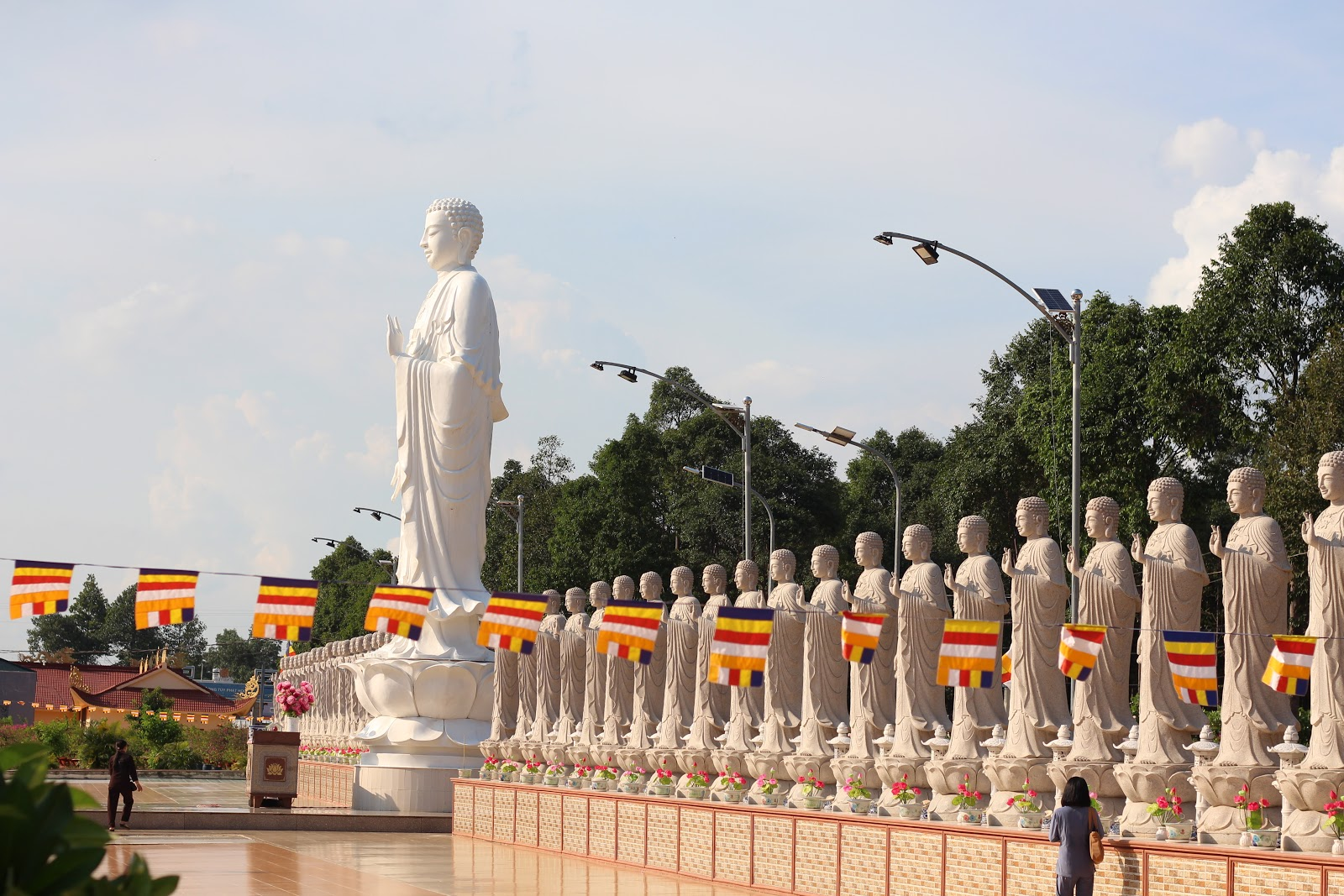
Buddhist statues inside Dai Tong Lam Pagoda in Vung Tau (Source: Collected)
A distinctive feature of the development of Dai Tong Lam Pagoda in Vung Tau is its harmonious balance between tradition and modernity. Despite its continuous expansion, the pagoda has retained the solemn and timeless character of Buddhist architecture while meeting the growing needs of religious activities. This development is reflected not only in the scale of its structures but also in the increasingly important role the pagoda plays in the spiritual and cultural life of the Buddhist community.
2.3. The Role and Position of Dai Tong Lam Pagoda in Contemporary Buddhist Life
After more than half a century of development, Dai Tong Lam Pagoda in Vung Tau has become an influential Buddhist center in southeastern Vietnam. It is not only a sacred pilgrimage destination visited by thousands of Buddhists each year, but also a center for monastic education, retreats, Buddhist assemblies, and large-scale religious activities. These activities contribute to nurturing spiritual life and helping people rediscover peace and compassion amid the rapid changes of modern life.
Beyond its religious role, the pagoda also holds significant cultural and educational value. Through Dharma talks, traditional festivals, and Buddhist guidance programs, Dai Tong Lam Pagoda in Vung Tau contributes to preserving and spreading the positive values of Vietnamese Buddhism. The harmonious combination of spiritual depth, historical significance, and humanistic values has made the pagoda a destination worth visiting for travelers, Buddhists, and anyone seeking inner peace.
3. Distinctive Architecture of Dai Tong Lam Pagoda in Vung Tau
3.1. An Architectural Complex Strongly Influenced by Traditional Buddhism
The architecture of Dai Tong Lam Pagoda in Vung Tau is rooted in traditional East Asian Buddhist principles, harmoniously combining impressive scale with solemnity and tranquility. The entire complex is organized along a symmetrical spatial axis, with the spiritual axis serving as the central focus. From the three-entrance gate, visitors are guided toward key functional areas such as the main hall, lecture halls, monastic quarters, and inner monastery. This arrangement not only reflects the philosophy of balance between yin and yang but also allows pilgrims to experience a sense of calm and solemnity from their very first steps into the complex.
A notable feature of the pagoda's architecture is its inheritance of traditional Vietnamese Buddhist architectural elements, expressed through multi-tiered curved roofs, gracefully upturned roof corners, and intricate decorative motifs rich in Buddhist symbolism. Details such as dragons, lotus flowers, Dharma wheels, and cloud patterns are meticulously carved, serving not only an aesthetic purpose but also conveying deeper philosophical meanings. Together, these elements create a harmonious whole that is both solemn and approachable, allowing visitors to easily sense the sacred atmosphere of the Buddhist sanctuary.
3.2. The Main Hall – The Spiritual Center of the Entire Complex
The main hall of Dai Tong Lam Pagoda in Vung Tau is regarded as one of the most important structures, serving as the spiritual center of the entire pagoda complex. Built on a large scale with a solid structure and imposing design, the building reflects profound reverence for the Buddha. Upon entering the main hall, visitors can immediately sense its solemn and contemplative atmosphere, characterized by gentle lighting, the fragrance of incense, and an unusual sense of stillness.
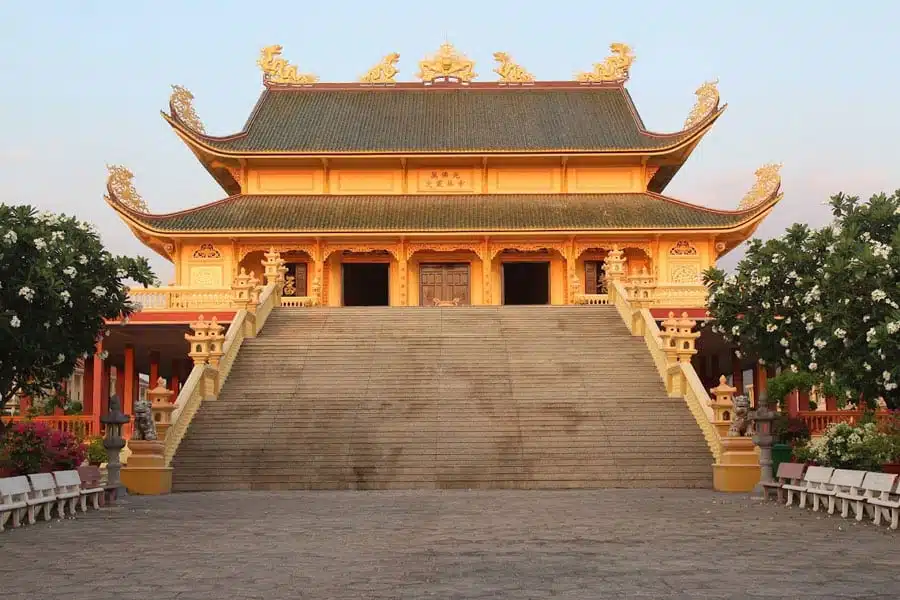
The exterior space of the main hall at Dai Tong Lam Pagoda in Vung Tau (Source: Collected)
Inside the main hall, Buddhist statues are respectfully arranged, with a statue of Shakyamuni Buddha occupying the central position, surrounded by Bodhisattvas and Dharma protectors. Each statue is intricately crafted, conveying an expression of compassion and dignity while contributing to the spiritual depth of the worship space. The main hall is not only the setting for important Buddhist ceremonies but also a place where Buddhists and visitors can reflect, quiet their minds, and rediscover a sense of peace amid the busyness of everyday life.
3.3. Large-Scale Buddhist Statues and Sculptural Works
One of the defining features of Dai Tong Lam Pagoda in Vung Tau is its monumental collection of Buddhist statues, regarded as one of the largest Buddhist statue complexes in Vietnam. Thousands of statues of various sizes are distributed throughout the grounds, from gardens and pathways to worship areas, creating an environment deeply infused with both spiritual and artistic character.
The sculptures at the pagoda possess not only religious significance but also considerable artistic and symbolic value. Each statue is meticulously crafted to convey the serenity and compassion of Buddhas and Bodhisattvas. Intricate carving combined with durable materials allows these works to possess both aesthetic value and lasting significance. This considerable investment has helped establish Dai Tong Lam Pagoda in Vung Tau as a notable cultural and spiritual destination in the region.
3.4. Lush Landscapes and Harmony with Nature
One of the elements that leaves a strong impression on visitors to Dai Tong Lam Pagoda in Vung Tau is its vast, lush, and carefully planned natural landscape. The grounds are surrounded by trees, lawns, ponds, and gently winding pathways, creating a sense of tranquility completely separated from the noise of the outside world.
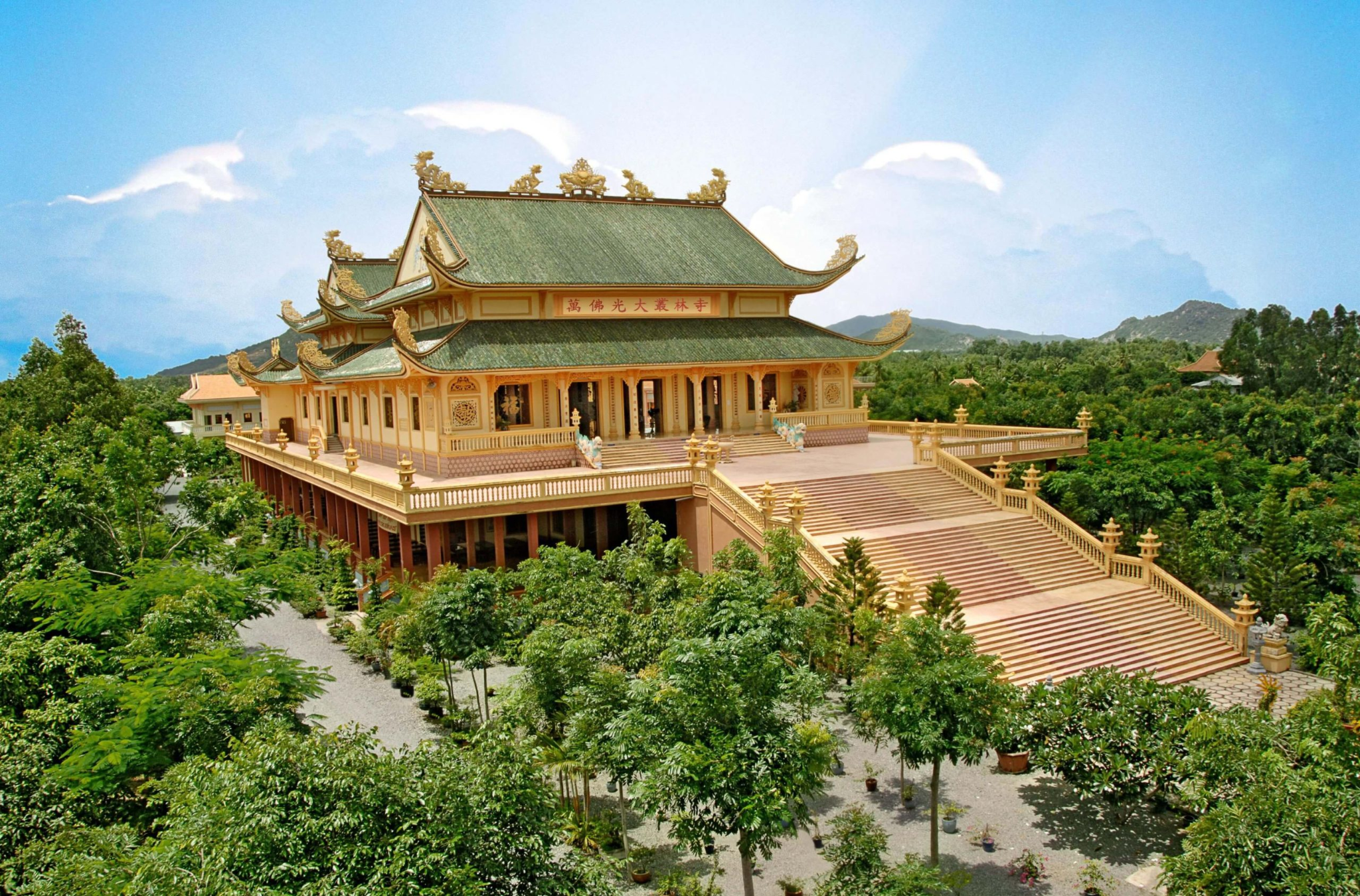
The green landscape surrounding the pagoda's main hall (Source: Collected)
The natural surroundings do more than enhance the scenery; they also play an important role in creating an environment conducive to meditation. The gentle rustling of leaves, birdsong, and the distant sound of temple bells create a tranquil atmosphere that allows people to let go of everyday worries. This harmonious integration of architecture and nature is one of the defining characteristics of Dai Tong Lam Pagoda in Vung Tau, turning each visit into an opportunity for contemplation and inner reflection.
The enduring appeal of Dai Tong Lam Pagoda in Vung Tau lies in the harmonious combination of architecture, art, and spiritual values. Every structure and sculptural detail serves not only an aesthetic function but also contains deeper messages about morality, human life, and Buddhist philosophy. From the overall spatial layout to the smallest decorative details, everything is oriented toward cultivating tranquility, mindfulness, and compassion.
This balance between material and spiritual values has allowed the pagoda to transcend the role of an ordinary tourist attraction and become a cultural and spiritual space with considerable depth. With these values, Dai Tong Lam Pagoda in Vung Tau is not only a sacred place of worship but also a destination where visitors can restore inner balance, nurture their spiritual lives, and experience the enduring beauty of Buddhism in contemporary life.
4. National Records of Dai Tong Lam Pagoda in Vung Tau
4.1. One of Vietnam's Largest Buddhist Statue Complexes with Tens of Thousands of Statues
One of the most notable features associated with Dai Tong Lam Pagoda in Vung Tau is its Buddhist statue complex, which is considered among the largest in Vietnam. According to various sources and practical records, the pagoda grounds currently contain more than 10,000 Buddhist statues of different sizes, distributed throughout areas including the main hall, ceremonial courtyards, pathways, statue gardens, and separate meditation spaces.
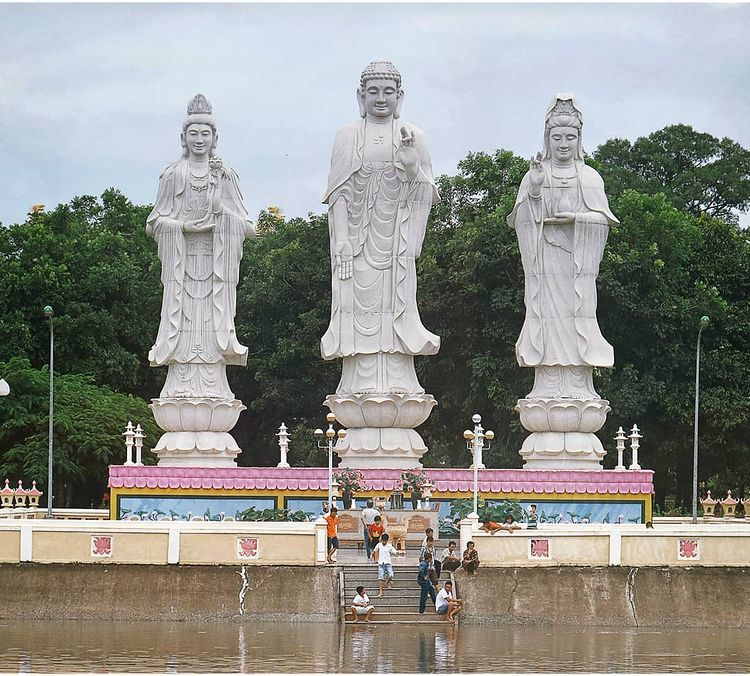
Massive Buddhist statues inside Dai Tong Lam Pagoda in Vung Tau (Source: Collected)
The statues are made from various materials, including stone, bronze, cement, and composite, with many featuring impressive dimensions that create a strong visual impact. They are not merely objects of worship; each statue represents a particular form, expression, and meaning within Buddhism, contributing to the solemn and contemplative atmosphere of the spiritual space. The sheer scale and unusual density of Buddhist statues have helped establish Dai Tong Lam Pagoda in Vung Tau as one of the largest Buddhist statue complexes in the country.
4.2. A Main Hall Among the Largest in the Vietnamese Buddhist System
Another notable record associated with Dai Tong Lam Pagoda in Vung Tau is its main hall, which ranks among the largest in Vietnam. The building covers an area of thousands of square meters, featuring a solid structure, a multi-tiered roof, and spacious interior areas capable of accommodating thousands of Buddhists during major Buddhist ceremonies.
Inside the main hall is a solemn arrangement of worship statues, with a large statue of Shakyamuni Buddha at the center, surrounded by Bodhisattvas and Dharma protectors. Despite its enormous size, the hall retains a sense of tranquility through its carefully designed layout, balanced lighting, and thoughtful spatial arrangement. The scale and architecture of the main hall not only reflect substantial investment but also demonstrate the stature of Dai Tong Lam Pagoda in Vung Tau within Vietnamese Buddhism.
4.3. A Buddhist Study and Practice Complex with Capacity for Thousands
Beyond its architecture and Buddhist statues, Dai Tong Lam Pagoda in Vung Tau is also known as one of the major centers for Buddhist study and practice in southern Vietnam. The grounds are divided into various functional areas, including lecture halls, monastic quarters, residential facilities, areas for Buddhist activities, and spaces for short- and long-term retreats.
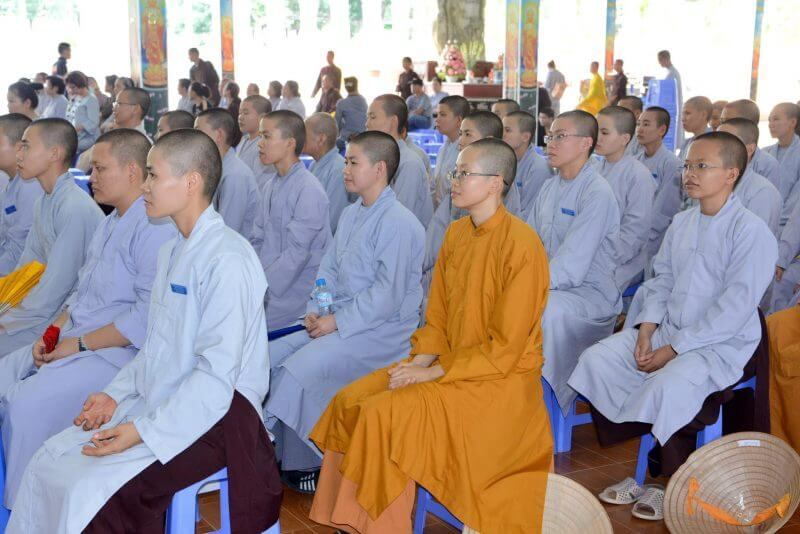
Dai Tong Lam Pagoda in Vung Tau is a place of Buddhist study and practice for many Buddhists (Source: Collected)
Thanks to its spacious grounds and comprehensive infrastructure, the pagoda can accommodate thousands of monks, nuns, Buddhists, and visitors at the same time, particularly during major occasions such as Buddha's Birthday, Vu Lan Festival, or summer retreats. Its large-scale activities, while maintaining order and solemnity, are one of the factors that have made Dai Tong Lam Pagoda in Vung Tau a prominent center for Buddhist study and practice in southern Vietnam.
4.4. A Rare Buddhist Architectural Complex Spanning Dozens of Hectares in Vietnam
Another notable record associated with Dai Tong Lam Pagoda in Vung Tau is its total grounds covering more than 54 hectares, placing it among the largest pagoda complexes in Vietnam today. This extensive area allows for the integrated development of functional zones such as the main hall, Buddhist statue areas, educational facilities, landscaped grounds, meditation gardens, and other supporting structures.
The overall open-plan design, which harmoniously integrates architecture and nature, has created a rare spiritual environment that is both imposing and tranquil. Its impressive scale and carefully organized layout have helped establish Dai Tong Lam Pagoda in Vung Tau as a prominent spiritual destination of national significance, with enduring cultural and spiritual value.
5. Outstanding Spiritual, Cultural, and Educational Values of Dai Tong Lam Pagoda in Vung Tau
5.1. Dai Tong Lam Pagoda in Vung Tau – A Major Buddhist Center in Southern Vietnam
Beyond being a large-scale architectural complex, Dai Tong Lam Pagoda in Vung Tau plays a particularly important role in the Buddhist life of southern Vietnam. Over the decades, the pagoda has become a major center for religious activities, Buddhist study, and the propagation of Buddhist teachings, bringing together large numbers of monks, nuns, and Buddhists from different provinces and cities to study, practice, and serve the Dharma.
The pagoda regularly organizes short- and long-term retreats for various groups, including young monks and nuns, lay Buddhists, and summer retreats for teenagers. In addition, Dai Tong Lam Pagoda in Vung Tau serves as a venue for systematic Buddhist education through Dharma classes, teachings, and the study of Buddhist scriptures, contributing significantly to the development of future generations of monks and nuns with ethical conduct, wisdom, and social responsibility. This role has helped establish the pagoda as one of the prominent Buddhist centers with a broad influence on the spiritual life of southern Vietnamese Buddhists.
5.2. Buddhist Philosophy Reflected Through Architecture and Sculpture
One of the key values contributing to the spiritual depth of Dai Tong Lam Pagoda in Vung Tau is its system of architecture and sculpture, which reflects Buddhist philosophy. Each structure and statue throughout the pagoda grounds is created with the intention of conveying messages about compassion, wisdom, and enlightenment. Familiar symbols such as lotus flowers, Dharma wheels, statues of Shakyamuni Buddha, Avalokitesvara Bodhisattva, and the Arhats carry profound meanings, reminding people to cultivate goodness and let go of greed, anger, and delusion.
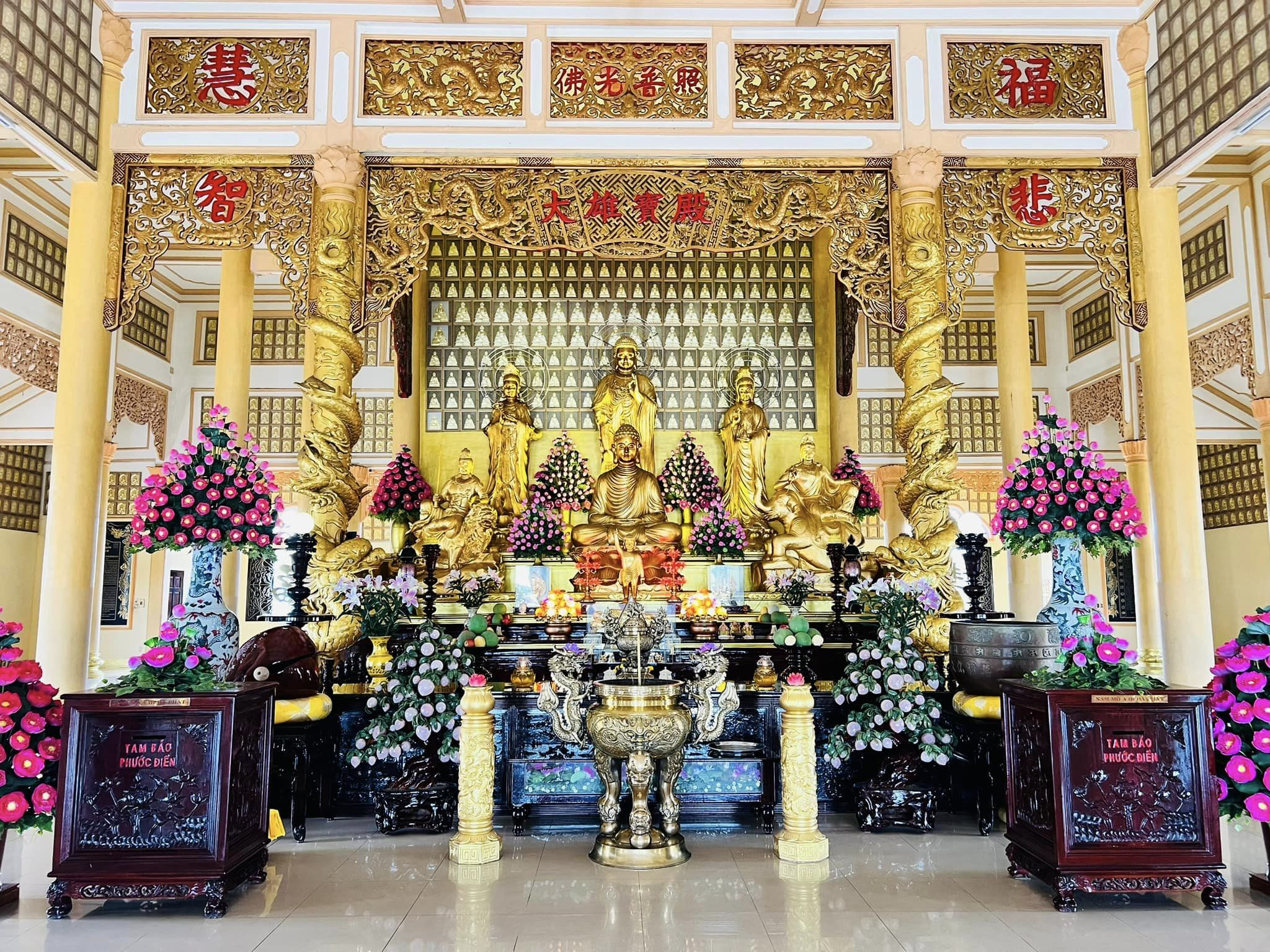
The pagoda's architecture reflects Buddhist philosophy (Source: Collected)
The architectural space of the pagoda is designed not only to create visual beauty but also to guide visitors through a spiritual journey. From the three-entrance gate and quiet pathways to the main hall and statue gardens, each step encourages contemplation and inner reflection. The harmonious combination of visual art and Buddhist thought has helped Dai Tong Lam Pagoda in Vung Tau become a place that spreads profound humanistic values and nurtures the spiritual life of the community.
5.3. Community Activities, Festivals, and Spiritual Experiences for Buddhists and Visitors
In addition to its role as a center for Buddhist study and practice, Dai Tong Lam Pagoda in Vung Tau is a familiar destination for large numbers of Buddhists and visitors during major occasions such as Buddha's Birthday, the Vu Lan Festival, New Year peace-prayer ceremonies, and summer retreats. These events often attract thousands of participants, creating an atmosphere that is solemn yet warm and welcoming.
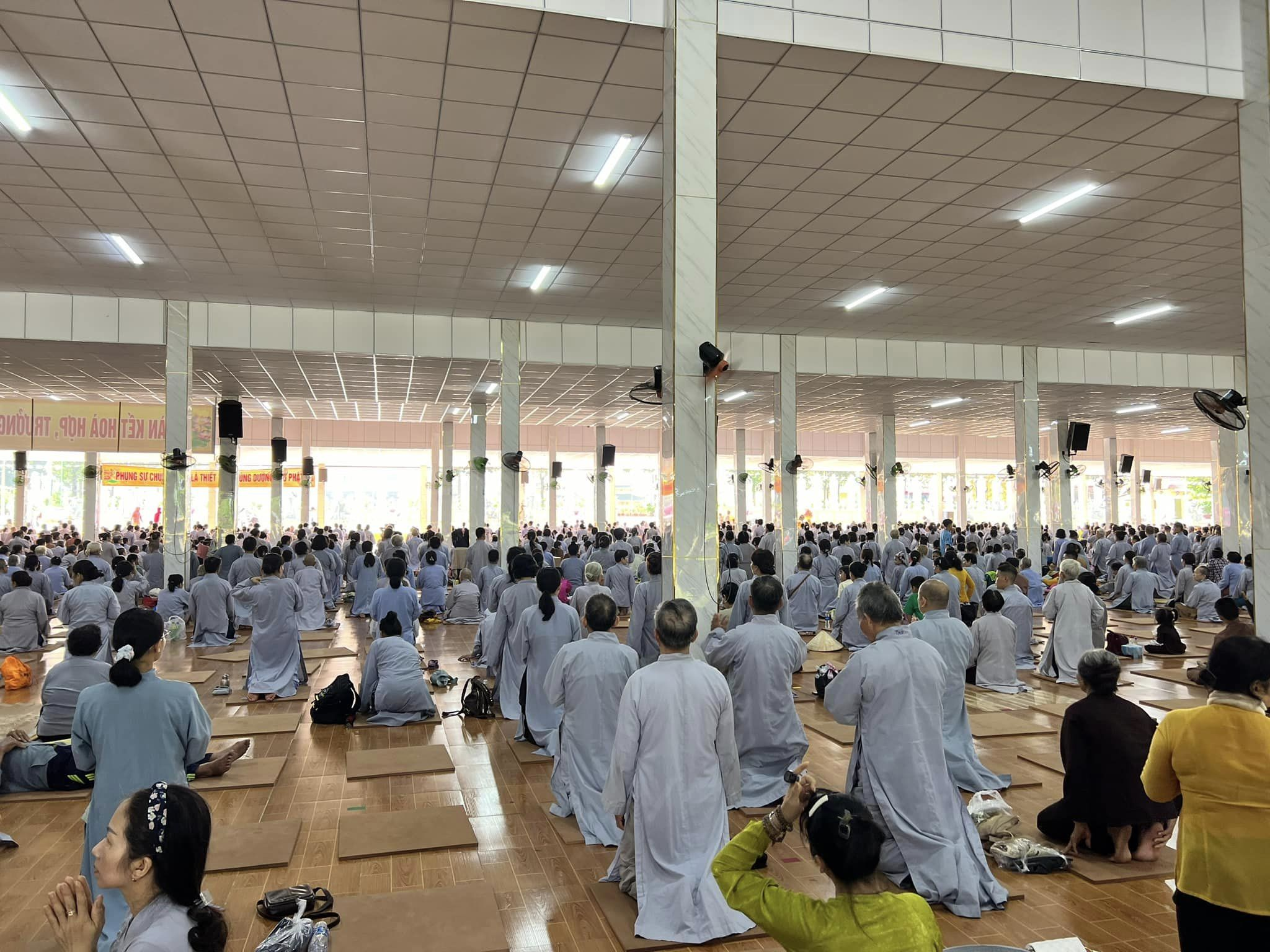
Buddhists practicing at the pagoda (Source: Collected)
In addition to religious ceremonies, the pagoda regularly organizes charitable activities, experiential retreats, vocational and character-development programs for young people, as well as community support initiatives. Visitors can not only pay homage and pray but also have opportunities to experience monastic life, listen to Dharma talks, and restore their inner balance after the pressures of everyday life.
This harmonious combination of spiritual, cultural, and community values has made Dai Tong Lam Pagoda in Vung Tau a destination of profound significance – not merely a place for sightseeing, but also a spiritual refuge for millions of Buddhists and visitors each year.
Beyond a pilgrimage to Dai Tong Lam Pagoda in Vung Tau, visitors to the coastal city can combine their journey with several other notable attractions to make the trip more complete. Vung Tau offers numerous appealing destinations, including Tam Thang Square – a vibrant nighttime light-filled space; the Statue of Christ the King on Small Mountain – one of the city's most famous landmarks; the historic White Palace with its distinctive French architectural heritage; and Vung Tau Lighthouse, which offers sweeping views of the sea and surrounding landscape. In addition, beaches such as Back Beach, Front Beach, Long Hai, and Ho Tram are ideal choices for relaxation, swimming, and enjoying fresh seafood.
With its impressive scale, profound spiritual significance, and distinctive architectural and artistic features, Dai Tong Lam Pagoda in Vung Tau is not only a sacred destination for Buddhists but also a notable cultural and spiritual landmark in southern Vietnam. It brings together tranquil landscapes, historical depth, and enduring humanistic values, offering visitors a sense of peace and contemplation amid the pace of modern life. Combining a visit to the pagoda with an exploration of Vung Tau can make the journey more complete, allowing travelers to nurture their spiritual well-being while creating lasting memories of a destination rich in cultural and spiritual identity.